

Current Market Solutions
At present, the main solution adopted by the market for the treatment of oily residues is incineration, in which the oil present in mill scale and metallic residues is burned and released as vapors and gases.
Beyond facing strict regulatory restrictions in many countries, this approach presents relevant technical limitations. In the case of metallic chips, their reduced thickness promotes excessive oxidation during combustion, resulting in loss of metallic value.
In many jurisdictions, oily mill scale and oily scrap are classified as hazardous waste under environmental regulations and are therefore directed to specialized landfills. These facilities entail significantly higher costs than landfills for inert industrial waste, increasing the overall economic burden on the steel industry.
Oily Residues Recovery
HpM has developed a technological process for the efficient removal of oils contained in residues from the steel industry, applicable to rolling mill scale, oily sludges, and metallic scrap generated by machining and stamping operations. The process was designed to enable the regeneration of these materials without the use of combustion, allowing their safe and environmentally sound reintegration into steelmaking operations.
Formation of Oily Residues in the Steel Industry – Mill Scale
During steel forming processes—such as continuous casting, rolling and wire drawing—the material, still at elevated temperatures, is subjected to intense mechanical deformation. Forming tools are cooled with water and lubricated with oils in order to preserve tool integrity and ensure stable operation.
The surface of hot steel, when simultaneously exposed to mechanical deformation and cooling, undergoes oxidation, forming predominantly wüstite (FeO). Throughout the process, these oxidized layers detach from the metallic substrate, generating mill scale. During generation and handling, mill scale frequently incorporates lubricating oils used in the equipment, rendering it unsuitable for direct reuse as an iron source in reduction processes.
Formation of Oily Feedstocks – Machining Chips and Stamping Scrap
In the case of machining chips and scrap generated from stamping operations, oil contamination is associated with tool and die lubrication and cooling. Machining centers, lathes, milling machines and similar equipment rely on water-oil emulsions for thermal control and tool protection, while in stamping operations oils are primarily used for die lubrication.
The residues generated by these processes are predominantly metallic; however, they contain oil levels that, although often lower than those found in fine machining chips, are sufficient to cause significant emissions when reused as scrap. In addition, certain lubricating oils may contain sulfur in their formulation, further restricting reinsertion into metallurgical processes.
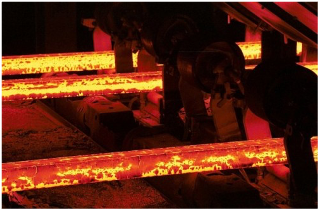


Image (A) shows the continuous casting process. The dark areas on the billets correspond to mill scale, mainly composed of iron oxides, mixed with oil and water from lubrication and cooling systems. Image (B) presents a hot-rolled coil, where mill scale is also clearly visible on the surface. Image (C) shows hot wire rod rolling, in which the scale formed is very thin and almost imperceptible.
The images are arranged according to scale particle size, from the coarsest image (A) to the finest image (C). Fine scale represents a particular challenge for steelmakers, especially regarding separation and proper handling.
Image (A)
Image (B)
Image (C)
Oily Scale Formation in Steelmaking Rolling Mill Works
Steel Oily Chip Formation During Machining (Oily Scrap)
Image (D) shows oil-contaminated steel chips generated during the machining of steel parts. Although the material is steel, the chips are coated with oil and water from cutting fluid systems used for tool lubrication and cooling. Images (E) and (F) present two different machining operations, both employing fluids for cooling and lubrication.
The chips generated in these processes remain contaminated with oil, which limits their direct use as steel scrap due to emissions generated during melting, either in BOF or EAF processes.
Image (D)
Image (E)
Image (F)
Oil Removal by Thermal Burning (Conventional Process)
Images (G), (H) and (I) show the current market practice for reducing oil content in oily mill scale and machining chips. In these processes, the oil is burned in furnaces, lowering the level of organic contamination in ferrous materials.
However, this approach generates toxic emissions, posing risks to both the environment and worker safety. In addition, high-temperature treatment promotes reoxidation, increasing the oxidation of mill scale (initially present as FeO) and converting metallic steel chips back into oxides, thereby reducing their metallurgical value.
Image (G)
Image (H)
Image (I)