

HpM Oil Removal Technical Principle
The HpM process for oil removal from oily residues is based on the generation of localized, microscale specific heat on surfaces where oil is adhered. This localized energy input reduces oil viscosity, promoting its detachment from the surface of solid particles, without the need for combustion or incineration.
Oil Separation Industrial Unity
The image below shows an operational unit of this technology at reduced scale (capacity of up to 2 tonnes per hour), in which mill scale treated by the HpM process has the oil efficiently separated. Both the recovered oil and the cleaned mill scale can then be directed to their most appropriate downstream applications.
Industrial Results from U.S. Steelmaking Residues
In the following set of images, material originating from a U.S. steel plant can be observed after undergoing the oil removal treatment, demonstrating the effectiveness of the technology in residue regeneration.
.jpeg)
Oily Residues Treatment – HpM General Process Scheme
Oily Scale Oil Removal Industrial Operation


Image (A)
Image (B)
Image (C)
Image (A) shows the HpM equipment used for the removal of oil from mill scale. The mill scale is mixed with water to form a slurry, which the exposed to localized microscale heat. This controlled energy input alters the oil viscosity, promoting is release from the surface of solid particles. Image (B) shows the mill scale after oil removal, now suitable for use as iron souce (FeO - wüstite) in reduction process. Image (C) shows the oil separated from the solids, which can be returned to the oil manufacturer for regeneration and reuse.
US Steelmaking Oily Scale Removal - Test and Analysis

Image (E)
Image (D) above shows an oily scale sample form a carbon steel US company with 5.2% oil content. Image (E) shows the scale after HpM's oil removal process, with 0.46% remaining oil.
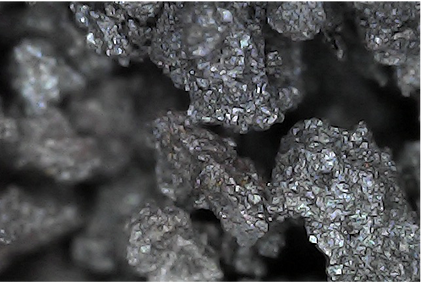

Image (F)
Image (G)
Image (D) shows a 600x magnified veiw of coarse mill scale coated with oil, containing 4.7% oil. Image (G) show a 600x magnified view of the same coarse scale after HpM process, now with residual oil content of 0.36%.
Clean Scale Applications and Metallurgical use of Clean Shavings Scrap
Additional images below illustrate laboratory-scale briquetting agglomeration of oil-free steel turnings intended for use as scrap. The densification achieved through briquetting significantly improves both the logistical handling and metallurgical efficiency of the material when reintroduced into steelmaking operations.


Image (H)
Image (I)
Image (H) and (I) show the procedure used to measure the initial and final oil content in oily residues. HpM applies Soxhlet extraction, using specific solvents selected to each type of oil identified in the residues. This technique ensures accurate determination of both initial and final oil content, without thermal or chemical processes that could interfere with the oxidation state of the mill scale, which is mostly composed of FeO (wüstite).
Oily Scale Oil Removal Industrial Application - ACO Iron Additive
The addition of clean mill scale to treated thin sludge for ACO Iron production increases the total iron content of the agglomerate, while improving its reducibility and productivity when used in the blast furnace.
This integrated approach strengthens the circular economy resilience of the recovery system, as material leakages from different steelmaking stages can be properly redirected to their most efficient metallurgical use within the steel plant.
Processing and Densification of Machining and Stamping Steel Shavings


Image (J)
Image (K)
Image (J) shows the processing and densification of steel scrap through roll briquetting in a laboratory-scale briquetting machine. Image (K) shows the production of steel shavings scrap bales using a hydralic press. Both materials can be safely used in BOF or EAF furnaces as scrap source, without the risk of emissions with oil burning emissions.
Image (D)
