

Desliming Process – Unlocking Value from Contaminated Mineral Streams
The presence of clays represents one of the major challenges in mineral processing. Their high specific surface area and the electrostatic charges acquired by the ore throughout crushing and comminution stages hinder mineral liberation and, in many cases, compromise the efficiency of subsequent separation processes.
It is often observed that mineral residues with high economic potential — such as magnetic by-products generated during the processing of non-ferrous ores or sandy materials with high quartz content — remain without commercial application due to contamination by clays or other ultra-fine particles that exhibit similar behavior. The selective removal of these contaminants can transform such mining co-products into viable industrial feedstocks, adding significant value and directly enhancing operational profitability.
Based on this opportunity, HpM adapted the CVBD – Continuous Vacuum Bubble Generation Duct for mineral processing applications. The process enables the efficient removal of contaminant particles through low specific energy physical mechanisms, promoting the dissipation of electrostatic charges and the selective mechanical disaggregation of fine particles adhered to mineral surfaces.
The box below presents two distinct desliming applications, demonstrating how mineral residues previously considered unsuitable for use can be cleaned and requalified for industrial applications, increasing value recovery and reducing the volume of material destined for tailings.
Quartz Residue Requalification through Desliming

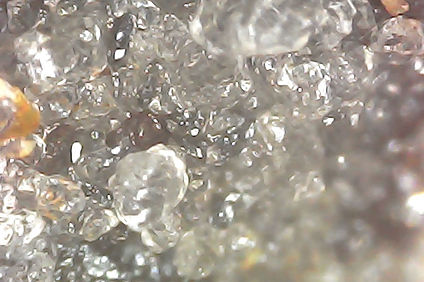
(A) Quartz tailing "in natura" before disliming
1,200 x magnification
(B) Quartz Tailing After CVBD Disliming Process
1,200 x magnification
Iron ore tailings frequently contain significant amounts of valuable iron-bearing minerals that remain unrecovered due to their ultra-fine particle size. HpM’s CVB-SR technology enables the selective liberation and recovery of these ultra-fine fractions, restoring the effectiveness of conventional mineral processing routes and converting previously discarded tailings into valuable resources.
Image (A) shows the quartz residue in natura, where the yellowish coloration clearly indicates the presence of clay coatings covering both the quartz surfaces and their interstitial spaces. These fine contaminants prevent the direct use of the material and typically result in its disposal in tailings facilities or stockpiles.
After processing through HpM’s CVBD – Continuous Vacuum Micro- and Nano-Bubble Generation Duct, shown in Image (B), the quartz surface is fully exposed and effectively cleaned. The clay previously adhered to the particle surfaces and trapped within interstices is selectively removed through a low-energy physical desliming mechanism.
HpM’s desliming process requalifies quartz residues previously considered waste, transforming materials originally destined for tailings dams or stacking into market-ready products with clear commercial value.
Magnetite Residue Desliming – Unlocking Trapped Mineral Value


(C) Magnetic Tailing "in natura"
no magnification
(D) Slurry Sampler
pre-CVBD
(E) Slurry Sampler
during CVBD
(F) Gravity Separation
by Shaking Table
(G) Heavy Material Magnetite
no magnification
(H) Light Material
no magnification
Image (C) shows a mineral beneficiation tailing generated during magnetic concentration, in which magnetite—acting as a contaminant to a non-ferrous and non-magnetic target mineral—remains electrostatically bound to the target mineral. While magnetic separation removes magnetite from the target mineral, the recovered magnetite fraction itself still carries a significant amount of the target mineral.
After repulping the material shown in Image (C), the slurry appearance remains visually unchanged prior to CVBD processing, as observed in Image (D). Once exposed to the action of micro- and nano-scale vacuum bubbles, a clear change in slurry behavior and color is observed in the sampler Image (E), indicating effective mineral liberation.
Subsequent gravity separation via shaking table Image (F) enables the physical segregation of both phases: liberated magnetite concentrates as the heavy fraction Image (G), while the non-magnetic mineral reports to the light fraction Image (H). As all images are shown without magnification, differences in particle size and morphology between both streams can be readily observed.